
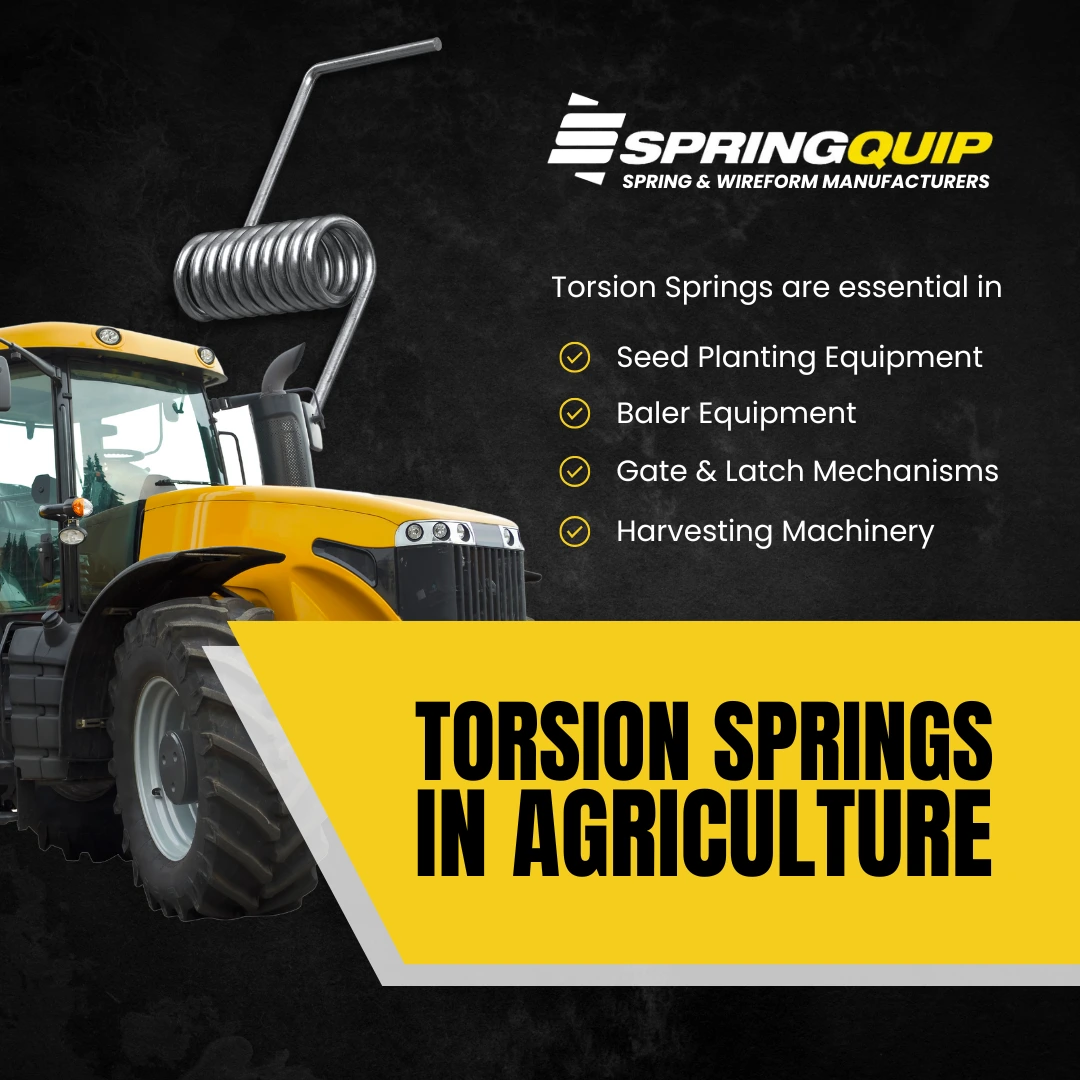
Agriculture relies on a wide range of machinery to keep operations efficient, from planting and harvesting to feeding and irrigation. Within these machines, even the smallest components play vital roles in ensuring reliable performance. Torsion springs, designed to handle rotational force, are one of these essential parts. Though compact, they enable precision, durability, and flexibility in agricultural equipment, making them indispensable across many applications. In this article, we’ll explore why torsion springs are so crucial to modern farming and how they help drive efficiency and productivity in key agricultural tasks.
Seed Planting Equipment
In seed planting equipment, the accuracy of seed placement is crucial for optimizing yield. Torsion springs in planters help control the mechanisms responsible for seed depth and spacing, ensuring that seeds are planted at the correct intervals and at the right depth for germination.
- Application Details: Torsion springs provide controlled rotational movement in the arms or plates that release seeds. This allows each seed to be deposited precisely as the machinery moves over the soil, avoiding both overcrowding and excessive spacing.
- Benefit: By maintaining even spacing and depth, torsion springs support optimal crop growth, helping farmers maximize their land use and achieve more consistent yields.
Baler Equipment
Bale wrappers and other baling machinery rely on torsion springs to apply consistent tension as bales are wrapped, securing feed tightly to prevent spoilage. A tightly wrapped bale preserves feed quality, reducing waste and storage costs.
- Application Details: In balers, torsion springs work in the wrapping arms or binding mechanisms, ensuring that each rotation applies even tension, tightly securing hay, straw, or silage. This prevents loose wrapping that could expose feed to moisture or contaminants.
- Benefit: By providing steady, reliable tension, torsion springs help keep bales tightly bound, preserving the nutritional quality of stored feed and reducing losses from spoilage.
Gate and Latch Mechanisms
In agriculture, gates and access points are constantly in use, whether for managing livestock or providing access to equipment storage. Torsion springs are essential in gate latches and hinge mechanisms, providing the necessary torque to keep gates secure yet easy to open and close.
- Application Details: Torsion springs are used in the hinge or latch mechanisms of gates, providing controlled movement that allows for easy, one-handed operation while also ensuring the gate remains securely closed when not in use.
- Benefit: Durable torsion springs prevent gates from sagging or loosening over time, supporting a safe environment for livestock management and protecting equipment from unauthorized access.
Harvesting Machinery
Harvesting machinery—such as combine harvesters and reapers—requires components that can withstand repeated, high-stress rotational movements as they gather crops. Torsion springs are used in various parts of this machinery to absorb shock, reduce wear, and allow for continuous motion during the harvesting process.
- Application Details: In combines, torsion springs are often found in reel mechanisms that guide crops toward the cutting head. The springs absorb the constant motion and jarring impact, helping to prevent excessive wear on moving parts and maintaining a steady feed of crops to the harvesting mechanism.
- Benefit: By absorbing shocks and providing flexibility, torsion springs extend the lifespan of harvesting components, reducing the need for repairs and ensuring a steady workflow during the critical harvest season.
Automatic Feeding Systems
Automatic feeding systems are widely used in livestock management, providing animals with a steady supply of feed. Torsion springs are often integrated into these systems, regulating the movement of levers and conveyors to ensure feed is delivered smoothly and consistently.
- Application Details: Torsion springs in feeders help control the opening and closing of chutes or gates, maintaining the right amount of tension to release feed gradually. They can also be used in conveyor mechanisms to handle rotational movements, ensuring feed is dispensed at a controlled rate.
- Benefit: With consistent tension from torsion springs, automatic feeders operate reliably, reducing manual feeding time and ensuring livestock have continuous access to feed, supporting animal health and productivity.
Rotary Tillers and Cultivators
Rotary tillers and cultivators rely on components that allow for depth control and consistent rotation to break up soil efficiently. Torsion springs in these machines manage the torque and flexibility required for blades and tines to maintain effective soil contact without excessive wear.
- Application Details: Torsion springs are used to adjust the angle and depth of the tiller’s tines or blades, helping to regulate the force applied to the soil. This allows the equipment to handle varying soil conditions while maintaining a steady tilling depth.
- Benefit: By providing flexible, adjustable torque, torsion springs enable tillers and cultivators to operate more effectively across different soil types, increasing efficiency and improving soil preparation for planting.
Irrigation Systems
In irrigation systems, torsion springs play an important role in managing the opening and closing of valves, ensuring that water flow is accurately regulated. These springs are crucial in pivot systems and sprinkler heads, where precision control is required to distribute water evenly across fields.
- Application Details: Torsion springs in sprinkler heads or valve systems provide the rotational force needed to open and close valves smoothly, maintaining consistent water pressure and distribution patterns.
- Benefit: By supporting precise valve operation, torsion springs help conserve water and ensure even irrigation, leading to healthier crops and more efficient water usage.
Conclusion
Torsion springs are integral to the functionality of a wide range of agricultural machinery, from seeders and balers to tillers and irrigation systems. Their ability to manage rotational force, maintain consistent tension, and absorb shock makes them invaluable for applications that demand durability and precision. Quality torsion springs support productivity, reduce equipment wear, and enhance the overall reliability of farm operations. At SpringQuip, we’re committed to providing high-performance torsion springs engineered for the unique needs of the agricultural industry.